
In short, what you will discover in this article: the clear and simple definition of the term nomad, its origins, its different forms, as well as the characteristics and benefits of the nomadic lifestyle. You will also understand how this concept applies today, notably with digital nomads.
1. Introduction — why search for “what does nomads mean”
The word nomads frequently comes up in discussions about alternative lifestyles, travel, or even technology. Understanding what does nomads mean helps to better grasp these conversations and enrich cultural knowledge. Whether to participate in a debate or simply satisfy curiosity, a clear definition is essential to avoid confusion.
2. Simple and direct definition of the term "nomad"
The term nomad mainly refers to a person or group who does not have a fixed residence and moves regularly. This way of life contrasts with that of sedentary people, who live in a stable place.
2.1 Definitions by context (anthropological, modern, digital)
- Anthropological: a people or tribe moving for economic, climatic, or social reasons, such as pastoral or hunter-gatherer peoples.
- Modern: a person adopting a mobile lifestyle, often by choice, like travelers or seasonal migrants.
- Digital: the term also applies to digital nomads, professionals who work remotely thanks to technology, often using an eSIM to stay connected everywhere.
2.2 Common synonyms and antonyms
Synonyms include itinerant, roaming, wandering, while antonyms are sedentary or homebody. These terms help better understand the nuances of nomadism depending on the context.
3. Origin and etymology of the word "nomad"
3.1 Historical roots and evolution of meaning
The word nomad comes from the ancient Greek nomas, meaning “wandering shepherd.” It passed through Latin before entering the French language in the 16th century. Initially linked to pastoral peoples, its meaning has broadened to denote any form of regular movement without a fixed home, including in the technological domain.
4. The different types of nomadism
4.1 Traditional nomadism (tribal, pastoral, itinerant)
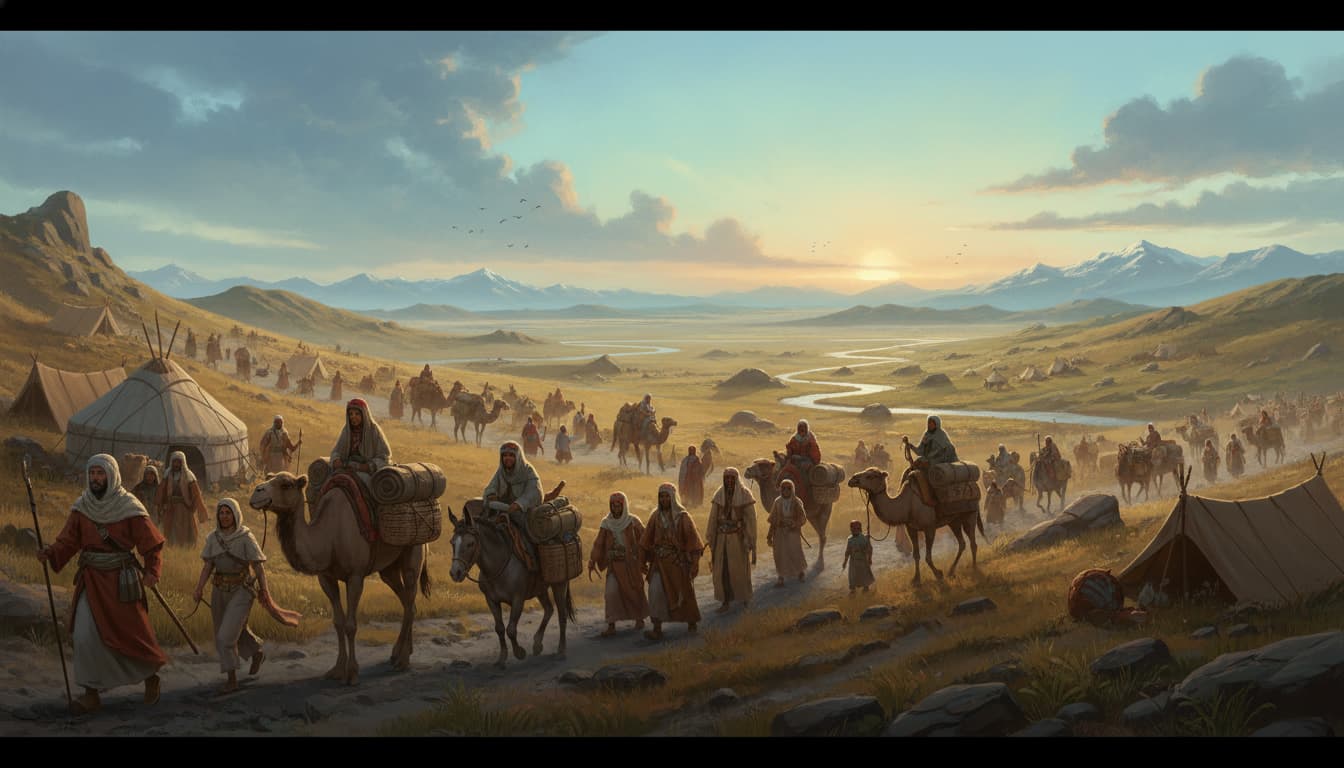
This lifestyle concerns human groups that move to follow their herds or search for resources, like the Tuaregs or Mongols. They often live in mobile shelters such as tents or yurts.
4.2 Urban nomads and seasonal migrants
These are people who frequently change residence for professional or economic reasons, without necessarily belonging to a traditional nomadic culture.
4.3 Digital nomads — contemporary specificities
Digital nomads use technology to work remotely, often while traveling. They rely on modern tools like eSIM to stay connected without geographical constraints. To learn more about activating this technology, check our full guide on how to install an eSIM.
5. Historical and contemporary examples of nomadic peoples
Scythians, Mongols, and Tuaregs are classic examples of nomadic peoples. Today, digital nomads represent a new form of nomadism, combining mobility and technology.
6. Characteristics of the nomadic lifestyle
6.1 Logistics and movement (habitat, transport)
Nomads use mobile habitats adapted to their movements, like nomad caravans or tents. Transportation can be on foot, horse, vehicle, or even by plane for modern nomads.
6.2 Economy and sources of income
Traditionally, the nomadic economy relies on herding, trade, or hunting. Contemporary nomads often earn their living through online activities, freelancing, or remote work.
6.3 Social and cultural life
Nomadic culture is rich in oral traditions, music, and crafts. Social life is often organized around community and exchanges between nomadic groups.
7. Advantages and disadvantages of nomadism
- Advantages: freedom of movement, discovery of new environments, professional flexibility (notably for digital nomads).
- Disadvantages: instability, difficulties accessing fixed services, administrative constraints.
8. Practical guide — how to become a nomad (if relevant)
8.1 Administrative and tax preparations
It is important to manage your tax residence and administrative documents well before adopting a nomadic lifestyle.
8.2 Health, safety, and insurance
Taking out appropriate health insurance and taking safety precautions are essential for frequent travel.
8.3 Budget, equipment, and essential tools
A flexible budget and tools like an eSIM facilitate mobility. To choose the best option, discover our article on the best travel eSIM.
9. Environmental impact and sustainability issues
Traditional nomadism can be sustainable if it respects natural resources. However, the increased mobility of modern nomads raises ecological questions, especially related to transportation.
10. Common myths and misconceptions (with factual corrections)
- Myth: Nomads are rootless and cultureless.
Reality: They have a rich culture and strong social ties. - Myth: Nomadism is an archaic lifestyle.
Reality: It adapts and evolves with technology, as shown by digital nomadism.
11. Resources, communities, and recommended readings
To deepen your understanding of nomads and their lifestyle, consult the Le Robert Dictionary which offers a complete and nuanced definition. The Larousse Dictionary provides valuable etymological and historical insights.
12. Conclusion
The term nomads covers a wide range of realities, from the traditional lifestyle to new digital forms. Understanding this diversity enriches our perspective on human mobility. To stay connected while traveling, feel free to explore our practical guides on eSIM and mobile technology.
Discover also how eSIM is revolutionizing the lives of modern nomads on Skyda.co.