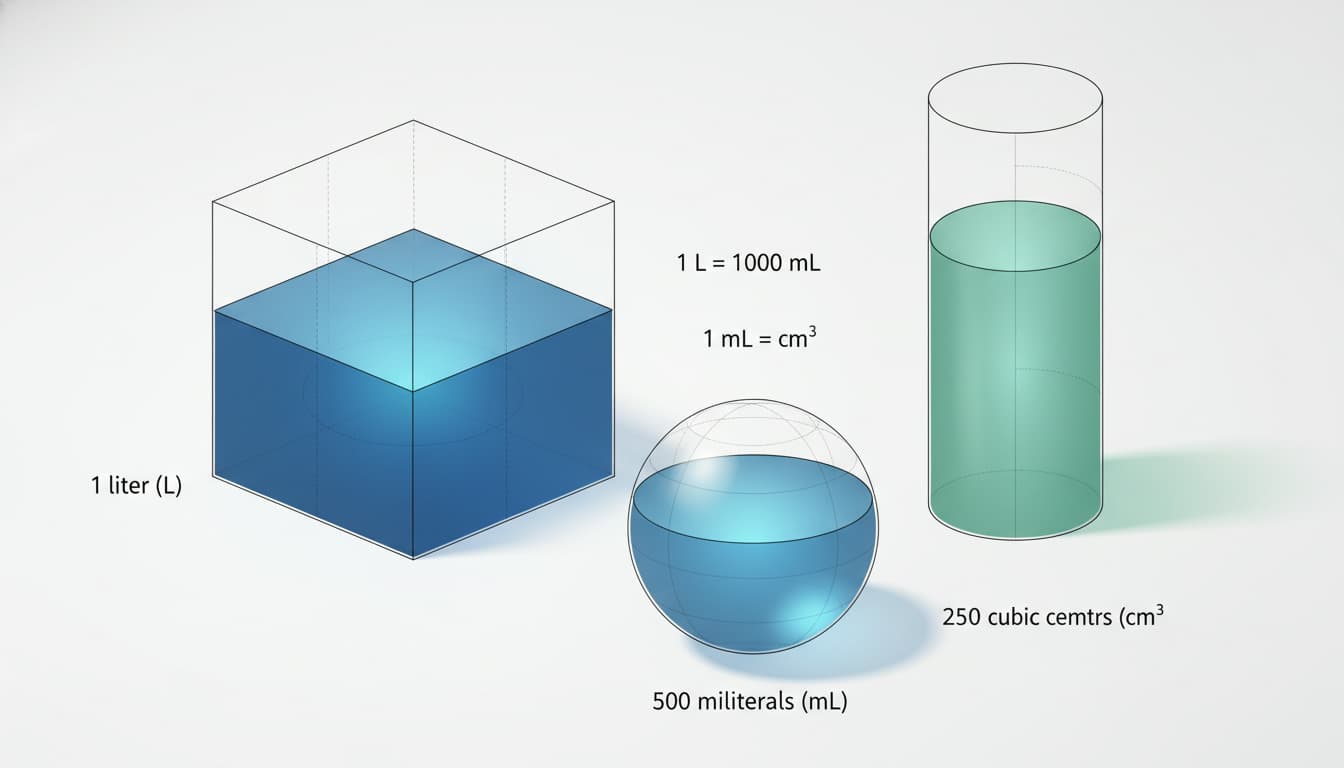

In short, what you will discover in this article: the definition of volume in physics, its units, how to calculate and measure it, as well as its relationships with other quantities like density. Clear explanations and concrete examples to fully understand this fundamental concept.
1. Definition of Volume in Physics
1.1 What is Volume? (Intuitive and Formal Definition)
Volume is a physical quantity that measures the three-dimensional space occupied by a body or a substance. Intuitively, it is the amount of space an object fills. Formally, volume corresponds to the measurement of extension in the three dimensions of space.
In physics, the definition of volume specifies that it is an extensive quantity, meaning the total volume of a whole is the sum of the volumes of its parts. For example, the volume of a liquid in a container can increase or decrease, but it can never be negative.
The volume of a solid, liquid, or gas is measured in specific units, and it is often linked to other physical quantities such as mass and pressure. For a rigorous definition, the page Volume - Wikipédia provides a complete scientific framework.
1.2 Volume vs. Area and Length — Key Distinctions
Unlike length, which measures a linear dimension, and area, which measures a two-dimensional surface, volume concerns the space in three dimensions.
- Length is expressed in meters (m).
- Area is expressed in square meters (m²).
- Volume is expressed in cubic meters (m³).
This distinction is essential to understand the different physical measurements and their applications.
2. Units of Volume and Conversions
2.1 SI Units (Cubic Meter) and Common Units (Liter, cm³)
The International System (SI) uses the cubic meter (m³) as the base unit for volume. One cubic meter corresponds to a cube with a 1-meter side.
However, in everyday life and laboratories, other units are often used:
- The liter (L), very common for liquids, equals 1 cubic decimeter (dm³), that is 0.001 m³.
- The cubic centimeter (cm³), used for smaller volumes, equals 10⁻⁶ m³.
These units facilitate measurement and communication in different contexts.
2.2 Tables and Practical Conversion Examples
Here is a simple table to convert the most common volume units:
| Unit | Equivalent in m³ |
|---|---|
| 1 m³ | 1 m³ |
| 1 liter (L) | 0.001 m³ |
| 1 cm³ | 0.000001 m³ (10⁻⁶ m³) |
| 1 milliliter | 0.000001 m³ (10⁻⁶ m³) |
For example, 2 liters correspond to 0.002 m³, and 500 cm³ to 0.0005 m³.
3. Calculating Volume — Formulas for Common Solids
3.1 Volume of Parallelepipeds, Cylinders, Spheres, Cones, Prisms
Volume calculation depends on the geometric shape of the solid. Here are the main formulas:
-
Rectangular Parallelepiped: ( V = L \times w \times h ) (Length × width × height)
-
Cylinder: ( V = \pi \times r^2 \times h ) (Base area × height)
-
Sphere: ( V = \frac{4}{3} \pi r^3 )
-
Cone: ( V = \frac{1}{3} \pi r^2 h )
-
Right Prism: ( V = \text{base area} \times h )
These formulas allow easy determination of the volume of a regular solid.
3.2 Volume of Composite Solids (Step-by-step Method)
For a composite solid, you can:
- Break down the shape into simple solids.
- Calculate the volume of each part using the appropriate formulas.
- Add the volumes to get the total volume.
This method is practical for complex objects.
4. Measuring Volume Experimentally
4.1 Water Displacement Method
The volume measurement of an irregular solid can be done by water displacement. The object is submerged in a graduated container filled with water, and the difference in water level is noted:
[ V = V_{\text{final}} - V_{\text{initial}} ]
For example, if the water level rises from 70 mL to 90 mL, the volume of the object is 20 mL (i.e., 20 cm³).
4.2 Measurements by Integration / Analytical Method
For complex shapes, volume can be calculated by mathematical integration, summing infinitely thin slices. This method is used in physics and engineering.
4.3 Advanced Techniques (Tomography, 3D Scanning) — Brief Overview
Modern technologies such as tomography or 3D scanning allow measuring volume with high precision, especially for biological or industrial objects.
5. Volume in Relation to Other Physical Quantities
5.1 Density and Related Calculations
Density (or mass density in physics) links the mass of a body to its volume:
[ \text{density} = \frac{\text{mass}}{\text{volume}} ]
It is expressed in kilograms per cubic meter (kg/m³). This relationship is essential to understand matter and its properties.
5.2 Applications: Hydrostatic Pressure, Volume Conservation
Volume also plays a role in physical phenomena like hydrostatic pressure, where pressure depends on the volume and height of the liquid. Moreover, in a closed system, the volume may remain constant, which is important in thermodynamics.
6. Common Errors and Practical Tips
6.1 Unit Pitfalls and Measurement Accuracy
It is common to confuse volume units, especially between liters and cubic meters. Always check the unit used and convert if necessary.
6.2 Quick Checks and Best Practices
- Use suitable instruments (graduated cylinders, rulers).
- For regular solids, verify dimension measurements.
- For liquids, avoid air bubbles that skew measurement.
7. Exercises with Solutions and Resources
7.1 Multiple Choice and Typical Problems (with Detailed Solutions)
To practice, it is helpful to do exercises on volume calculation, unit conversion, and experimental measurement. These exercises reinforce understanding.
7.2 Downloadable Summary Sheet
A summary sheet of volume formulas and units is a practical tool for quick review.
8. Conclusion
Volume in physics is a fundamental concept measuring the space occupied by a body in three dimensions. Understanding its units, calculation methods, and measurement techniques is essential to progress in physics. For further study, you can consult detailed resources like Volume - Wikipédia.
To go further in mastering modern technologies, especially mobile connectivity, discover how an eSIM works and follow our practical guides to install it easily.
Mastering these concepts will help you better grasp physics and the technologies around you.