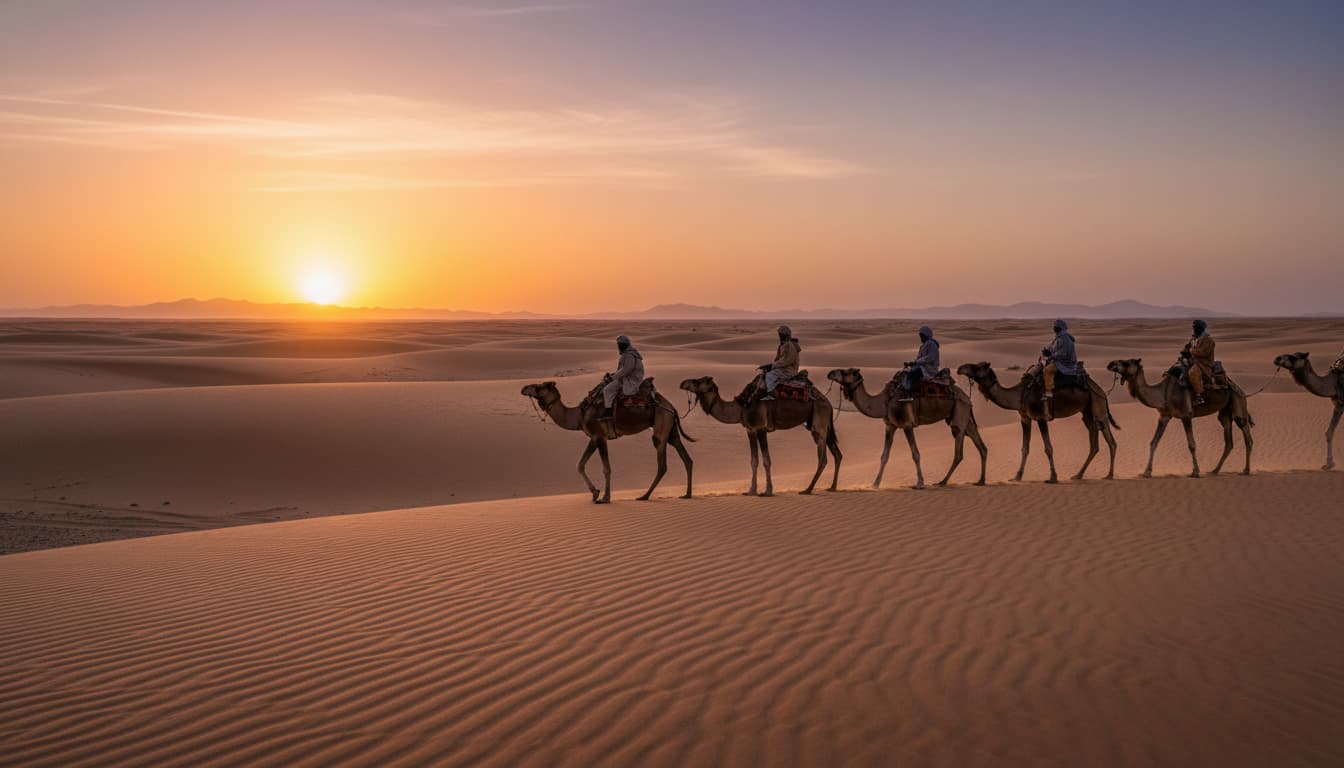

In brief, what you will discover in this article: the clear and complete definition of the term nomad, its origin, its various historical and modern forms, as well as the cultural, social, and legal issues related to this way of life. You will also understand the distinctions with migrants and discover concrete examples of nomadic peoples and digital nomads today.
1. Simple Definition: What is a “Nomad”?
A nomad refers to a person or group who does not have a fixed residence and moves regularly. This way of life contrasts with sedentarism, where individuals live stably in a specific place. The notion of nomadism also applies to migratory animals and, more recently, to lifestyles or activities characterized by constant mobility.
This simple definition therefore encompasses the traditional nomadic life, as well as modern uses such as nomadic work, where mobility is made possible by technology, notably thanks to the eSIM, highly favored by travelers and mobile professionals.
1.1 Origin and Etymology of the Word “Nomad”
The term “nomad” comes from the ancient Greek nomas, meaning “itinerant shepherd.” This origin reflects one of the oldest forms of nomadism: the movement of herds to find pastures and resources.
The etymology emphasizes the idea of permanent movement, a fundamental characteristic of nomadic movements. Over time, this meaning has extended to designate not only pastoral peoples but also other human groups and even modern concepts related to mobility.
1.2 Encyclopedic / Academic Definition
According to the Le Robert Dictionary, a nomad is an individual or group wandering without a fixed home, often contrasted with sedentary people. The French Academy specifies that this term also applies to non-migratory but itinerant animals, and that figurative uses exist to describe changeable temperaments.
This academic definition clearly distinguishes nomadism as a social, cultural, and sometimes legal status, notably for people without stable residence, which has important implications in terms of access to rights and services.
2. Different Forms of Nomadism
Nomadism is not limited to a single way of life. There are several historical and contemporary forms, each with its own characteristics.
2.1 Pastoral Nomadism
Pastoral nomadism concerns peoples who move their herds to access seasonal pastures. This way of life is traditionally associated with arid or mountainous regions where sedentary agriculture is difficult.
2.2 Hunter-Gatherer Nomadism
Hunter-gatherer groups practice nomadism based on the search for natural resources, such as wildlife and plants. Their mobility is dictated by natural cycles and food availability.
2.3 Commercial and Caravan Nomadism
This type of nomadism involves regular travel for trade, often over long distances. Historical caravans in Asia and Africa well illustrate this lifestyle, combining mobility and economic exchanges.
2.4 Contemporary Nomadism: Digital Nomads
Modern nomads include digital nomads, who use mobile technologies, notably the eSIM, to work remotely while traveling. This lifestyle combines mobility and connectivity, offering a new form of geographic freedom.
To learn more about the eSIM and its role in modern mobility, check out our full article on what is an eSIM.
3. Why Are Some Populations Nomadic? (Causes and Factors)
Several factors explain the choice or necessity of a nomadic way of life.
3.1 Environmental and Climatic Factors
Climatic conditions such as drought or resource seasonality push some groups to move to survive. Pastoral nomadism is a typical example of this adaptation.
3.2 Economic and Political Factors
Economic constraints, conflicts, or exclusionary policies can also force populations to adopt a nomadic lifestyle, sometimes temporarily, sometimes over multiple generations.
4. Nomad vs Migrant: Differences and Similarities
Although close, the terms nomad and migrant are not synonyms. A migrant generally moves to settle elsewhere more or less permanently, often for economic or political reasons. A nomad is characterized by cyclical or permanent mobility without fixed settlement.
This distinction is important for understanding the social and legal issues related to these populations.
5. Cultural and Social Aspects of Nomadism
5.1 Social Organization, Language, and Traditions
Nomadic peoples often develop specific social structures, with languages, customs, and traditions adapted to their mobility. Nomadic culture values flexibility, solidarity, and knowledge of the territories traveled.
6. Legal Issues and Access to Services
Nomadic people often face difficulties accessing public services, education, or healthcare due to their lack of fixed residence. The legal framework varies by country, and some states recognize specific statuses for these populations.
7. Myths and Misconceptions About Nomads
Several false ideas circulate about nomads, such as the image of a primitive or unstable lifestyle. In reality, nomadism is a complex system adapted to specific environments and historical contexts, and it can be a source of social and economic innovation.
8. Contemporary Examples and Case Studies
8.1 Nomadic Peoples Still Present (by Region)
- The Tuaregs in the Saharan Africa
- The Bedouins in the Middle East
- The Mongols in Central Asia
These groups maintain traditional nomadic lifestyles, often adapted to modern constraints.
8.2 Profiles of Digital Nomads (Lifestyle, Advantages, Challenges)
Digital nomads often live in connected cities or travel between several countries, enjoying the flexibility offered by mobile technologies. Their lifestyle offers advantages such as geographic freedom, but also challenges related to administrative management and stability.
To discover the best solutions for staying connected while traveling, especially with an eSIM, check out our comparison of the best eSIMs for travel.
9. Environmental Impact and Sustainability
Nomadism can have varied impacts on the environment. Traditionally, it promotes sustainable resource management through mobility. However, some modern forms, especially related to tourism or technology, present new challenges.
10. Resources for Further Reading (Books, Studies, NGOs)
To deepen the definition of nomadism and its issues, dictionaries like Larousse offer rich and educational perspectives. Many NGOs also work toward the recognition and support of nomadic populations worldwide.
11. Conclusion: Summary and Recommended Operational Definition
In summary, a nomad is a person or group characterized by regular mobility and absence of fixed residence, a lifestyle that can be traditional or modernized, like that of digital nomads. Understanding this definition allows for a better grasp of the cultural, social, and technological issues related to human mobility.
To stay connected wherever you are, remember that the eSIM is a key solution for modern nomads, facilitating Internet access without geographic constraints. Discover how to install it in our practical guide on how to install an eSIM.