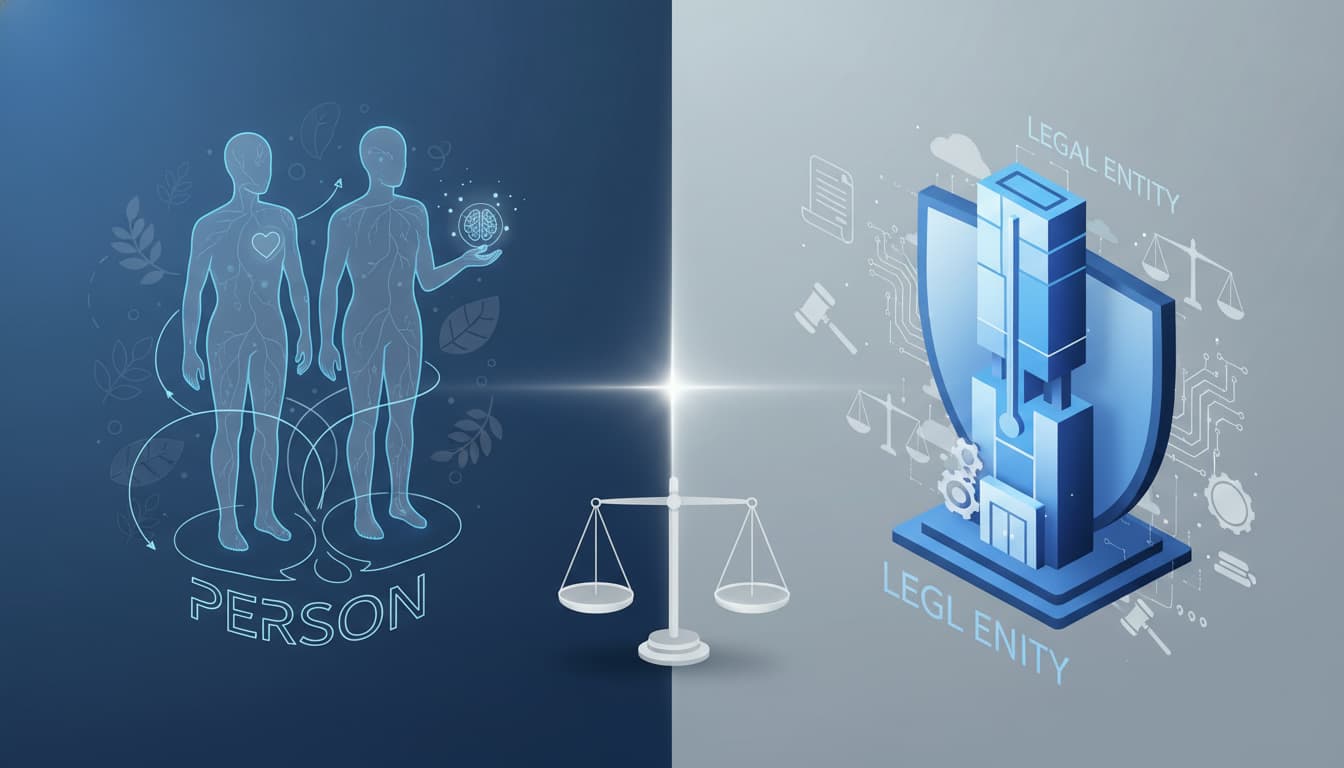

In short, what you will learn in this article: the essential distinction between a legal entity and a natural person, explained simply with concrete examples. You will understand their rights, obligations, and how to choose the appropriate status for your administrative or entrepreneurial project.
1. Introduction: Stakes and Definition of the Subject
Understanding the difference between a legal entity and a natural person is crucial in an administrative or legal context. These concepts define who can have rights, obligations, and how these entities interact with the law. Whether filling out a form, creating a business, or managing an association, grasping these ideas will prevent confusion and make your processes easier.
2. What Is a Natural Person?
2.1 Legal Definition
A natural person is a human being recognized by law as holder of rights and obligations. They acquire legal personality at birth and have legal capacities allowing them to take legal action, enter into contracts, or exercise civil rights.
2.2 Rights and Capacities (e.g., legal capacity, majority age)
A natural person benefits from fundamental rights such as the right to life, liberty, or property. Their legal capacity is generally full upon reaching majority age, except in cases of guardianship or emancipation. They incur civil and criminal liability in case of unlawful acts.
2.3 Concrete Example
An individual who signs an employment contract or buys real estate acts as a natural person. Their tax and social obligations are personal, and their assets are directly at risk in case of debts.
3. What Is a Legal Entity?
3.1 Legal Definition
A legal entity is a legal construct created by law or an official act, distinct from the individuals who compose it. It has its own legal personality, allowing it to hold assets, enter contracts, and act in court through its representatives.
3.2 Types of Legal Entities (associations, companies, foundations, etc.)
Several types of legal entities can be distinguished:
- Private law legal entities: commercial companies (LLC, simplified joint-stock company), associations under the 1901 law, foundations.
- Public law legal entities: the State, local authorities, public institutions.
3.3 Representation and Organs (leaders, assemblies)
A legal entity acts through its organs, such as a president, manager, or board of directors. These representatives have the power to commit the legal entity to legal acts, while respecting the rules set by its bylaws.
4. Main Differences Between a Natural Person and a Legal Entity
4.1 Civil and Criminal Liability
A natural person has direct and personal liability. In contrast, a legal entity has liability distinct from its members, which often limits the liability of its leaders.
4.2 Assets and Separation of Property
A natural person has a single estate, mixing personal and professional assets. A legal entity owns its own assets, separate from those of its members, which protects the personal property of partners or members.
4.3 Taxation and Accounting Obligations
The tax regime of legal entities differs from that of natural persons. For example, a company is subject to corporate tax, while an individual pays income tax. Additionally, legal entities have stricter accounting obligations, such as keeping annual accounts.
5. How to Choose Between Operating as a Natural Person or Creating a Legal Entity?
5.1 Selection Criteria (risks, taxation, financing, image)
To choose, consider:
- The level of liability you are willing to assume.
- The tax advantages linked to each status.
- Ease of access to financing.
- The professional image you want to convey.
5.2 Decision Checklist
- Do I need to protect my personal assets?
- Does my activity require an official structure?
- Which tax regime is most advantageous for me?
- Do I need partners or associates?
6. Practical Processes: Creation, Transformation, Dissolution
6.1 Creating a Legal Entity: Key Steps
- Draft the bylaws.
- Deposit share capital if necessary.
- Publish a notice of creation.
- Register the legal entity with the competent authorities.
6.2 Transforming a Natural Person into a Legal Entity
This transformation involves creating a distinct legal entity, often to benefit from better protection or an adapted tax regime.
6.3 Dissolution/Liquidation: Impacts for Involved Natural Persons
The dissolution of a legal entity leads to the liquidation of its assets. Associated natural persons may have their liability engaged according to the provisions of law and bylaws.
7. Practical Cases and Comparative Examples
7.1 Comparative Scenarios (micro-business vs LLC vs simplified joint-stock company)
| Status | Liability | Taxation | Formalities |
|---|---|---|---|
| Micro-business | Unlimited (personal) | Income tax | Simplified |
| LLC | Limited to capital | Corporate tax or income tax | More complex |
| Simplified Joint-Stock Company | Limited to capital | Corporate tax | Flexible |
7.2 Real or Simulated Case Studies
For example, a 1901 law association can manage a social project without engaging the personal liability of its members, unlike a sole entrepreneur.
8. Advanced Legal Questions and Useful Case Law
8.1 Liability of Leaders
Leaders of legal entities can be held liable in case of mismanagement, but their liability is often limited by the legal structure.
8.2 Protection of Personal Assets
Creating a legal entity allows the separation of personal assets from business assets, thus offering significant protection in case of difficulties.
9. Conclusion: Summary and Recommendations
The distinction between legal entity or natural person is based on legal nature, rights, obligations, and liabilities. Choosing the right status simplifies administrative management and protects your interests. To deepen your understanding, discover our comprehensive guide on the legal status of the legal entity which will help you grasp the practical implications.
To go further, you can consult the detailed article from Agence Juridique on the Differences Between Legal Entity and Natural Person which offers a clear and structured analysis of the concepts discussed here.
Finally, if you wish to master the technical aspects related to mobile connectivity in your projects, feel free to read our guide on how to install an eSIM, a key technology for mobile professionals.