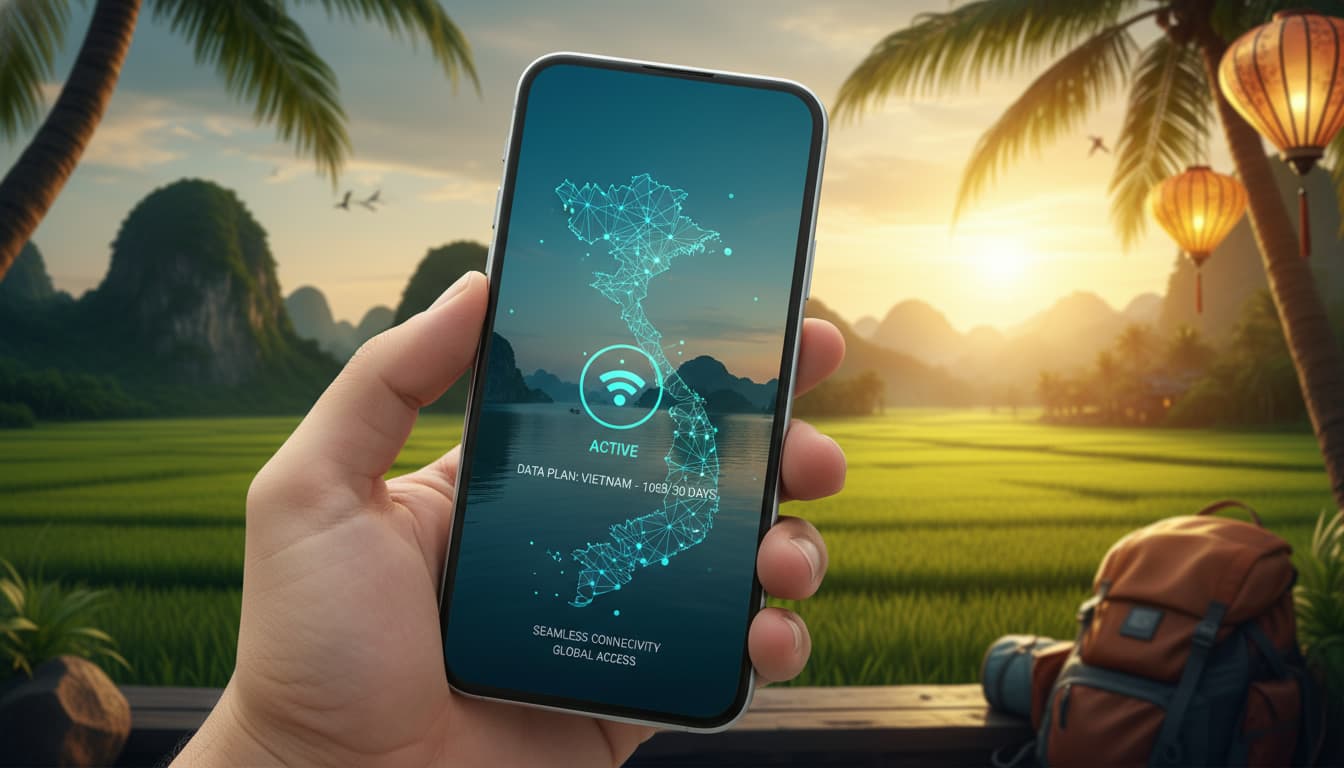

In short, what you'll discover in this article: how to choose, buy, and activate an eSIM for your trip to Vietnam. You will learn everything about operators, plans, network coverage, and tips to stay connected without a physical SIM card.
1. Why choose an eSIM for traveling to Vietnam
The eSIM Vietnam mobile travel is an ideal solution for travelers wanting to avoid the constraints of physical SIM cards. It allows quick activation, no waiting lines at the airport, and offers flexibility to manage multiple plans. This way you benefit from a reliable mobile internet connection in Vietnam, essential for browsing, calling, or sharing your memories with ease.
2. What is an eSIM?
2.1 Definition and how it works
The eSIM is a digital SIM card embedded in your phone. It replaces the physical SIM card and allows you to activate a mobile plan via a profile downloaded, often by scanning a QR code. This technology makes managing multiple plans easier without swapping cards.
2.2 Device compatibility (iPhone, Android, compatible models)
Phone compatibility with eSIM is key. Recent models like the iPhone XS and later, as well as some Samsung Galaxy S20+ and newer, support eSIM. Before your trip, check that your smartphone is compatible to fully benefit from the eSIM card for Vietnam. To better understand the basics, you can consult our full article on what is an eSIM.
3. Advantages and disadvantages of an eSIM when traveling
3.1 Advantages: instant activation, multiple plans, no physical card
The eSIM offers several major advantages:
- Instant activation by scanning a QR code, often even before arriving in Vietnam.
- Ability to manage multiple plans on the same device, convenient for long stays or multi-destination trips.
- No need to handle a physical SIM card, avoiding loss or insertion issues.
3.2 Limitations: compatibility, reversibility, technical support
However, some limitations exist:
- Not all phones are compatible.
- Reversing to a physical SIM can be complex.
- Technical support may be limited depending on the provider.
4. eSIM options for Vietnam
4.1 International providers vs local operators
For your mobile travel eSIM plan, you can choose between:
- International providers like Airalo, Holafly, or Nomad, offering prepaid plans easy to buy online.
- Local Vietnamese operators such as Viettel, Vinaphone, and Mobifone, providing reliable 4G/5G coverage in major cities and tourist areas.
4.2 Prepaid plans vs long-term subscriptions
eSIM offers for tourists are generally prepaid, suited for short stays. For longer trips, long-term subscriptions are possible, often through local operators. To deepen setup knowledge, check our guide on how to install an eSIM.
5. How to buy and activate an eSIM in Vietnam
5.1 Purchase steps (website/app, payment)
Buying an eSIM is done in a few clicks on the provider's website or app. You select a Vietnam plan tailored to your stay length and data volume, then pay online.
5.2 Activation (QR code, app, eSIM profile)
After payment, you receive a QR code to scan in your phone settings. Activation can happen before departure or upon arrival by enabling roaming. This step is simple and fast.
5.3 Post-activation checks (APN, roaming, data test)
Once activated, verify APN settings are correct and roaming is enabled. Test the connection to ensure everything works well. In case of issues, our article on long stay eSIM travel offers practical solutions.
6. Coverage, network quality, and on-site recommendations
6.1 4G/5G coverage in urban vs rural areas
Mobile network in Vietnam is strong in 4G, even 5G, in large cities like Hanoi, Ho Chi Minh, Da Nang, or Hoi An. In rural areas, coverage may be more limited, which can impact mobile internet connection in Vietnam.
6.2 Tips for low coverage areas (local SIM, Wi-Fi)
In low coverage zones, it is advised to:
- Use Wi-Fi available in hotels or cafes.
- Have a local SIM as a backup if you need a constant connection.
7. Price / data / duration comparison of offers (concrete examples)
To effectively compare offers, consider:
- The price of the eSIM in Vietnam per GB of data.
- The validity of the plan (days or months).
- Customer support and ease of activation.
Here is a simplified comparison example:
| Provider | Price (USD) | Data (GB) | Validity | Support |
|---|---|---|---|---|
| Airalo | 10 | 3 | 15 days | |
| Holafly | 20 | 5 | 30 days | Chat |
| Viettel | 15 | 4 | 30 days | Store |
8. Common issues and solutions (troubleshooting)
8.1 Activation issues, dual-SIM conflicts, loss of connection
Common problems include:
- Difficulty scanning the QR code.
- Conflicts between eSIM and physical SIM in dual-SIM mode.
- Loss of connection due to incorrect APN settings.
To fix these issues, verify your phone's compatibility, follow the provider's instructions, and restart your device. When in doubt, our installation guide is a valuable resource.
9. Practical tips for travelers
9.1 Prepare your phone before departure (backup, unlocking operator lock)
Before leaving, back up your data and make sure your phone is not locked to a specific carrier. This facilitates eSIM activation.
9.2 Tips: tethering, useful apps, offline backup
- Enable tethering if you want to connect other devices.
- Install useful apps like VPNs to secure your browsing.
- Backup maps and guides offline to avoid dependency on connection.
10. Conclusion
The eSIM Vietnam mobile travel is a modern and practical solution to stay connected without constraints during your stay. By choosing the best eSIM for travel, you benefit from a reliable connection, easy to activate and tailored to your needs. To prepare your departure, don’t hesitate to consult our comprehensive guides and choose your plan on Skyda.co.
Enjoy your trip to Vietnam with optimized and secure mobile connectivity!