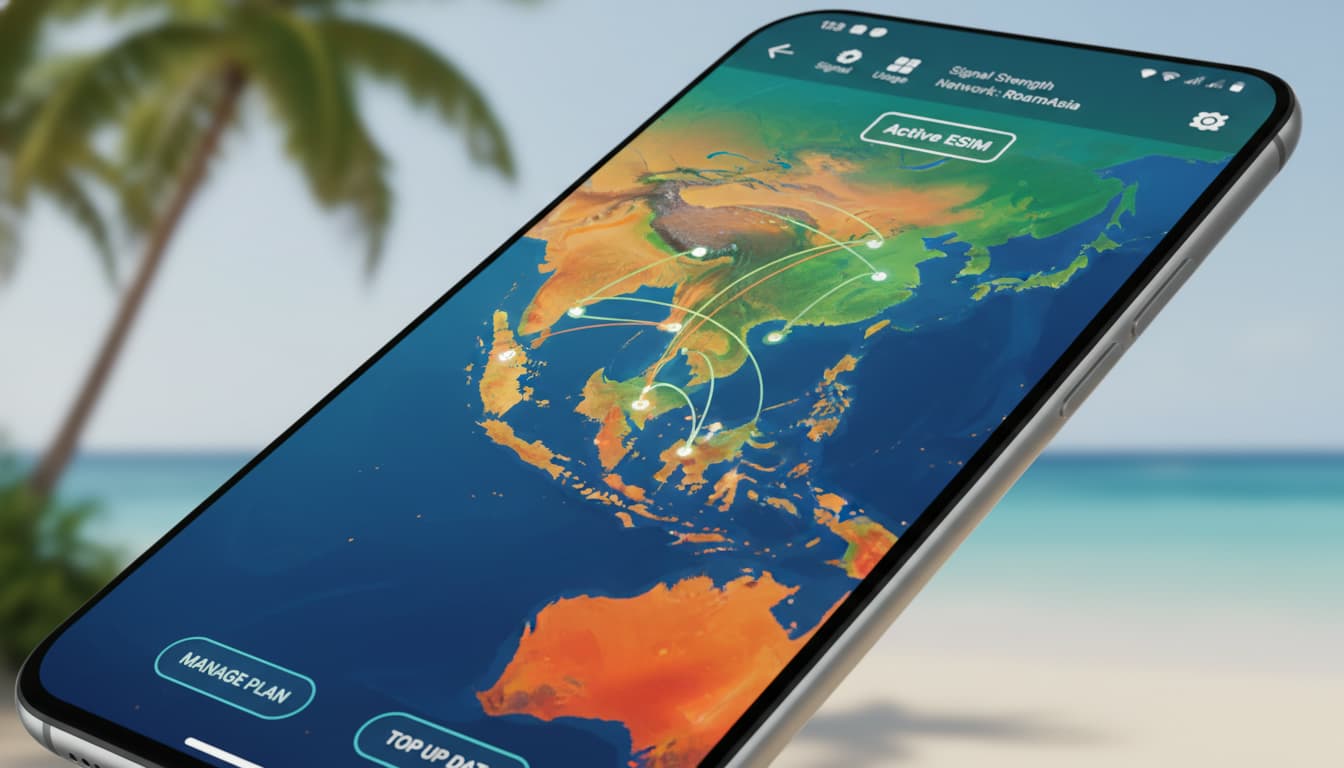

In short, what you will learn in this article: why the Southeast Asia eSIM is the ideal solution to stay connected hassle-free, how to choose and activate your eSIM, and tips to enhance your travel experience in this dynamic region.
1. Introduction: why choose an eSIM for Southeast Asia
Traveling in Southeast Asia with an eSIM offers unprecedented freedom. No more waiting in line to buy a local SIM card at every border. With the eSIM in Southeast Asia, you benefit from a seamless, fast, and affordable connection across multiple countries without physically changing your card. This technology simplifies trip preparation and avoids excessive roaming fees.
Moreover, the eSIM plan for Southeast Asia often allows unrestricted tethering, ideal for connected travelers. You save time, money, and most importantly peace of mind, even during extended or on-the-go stays.
2. What is an eSIM?
2.1 Definition and technical operation
The eSIM is a virtual SIM card embedded in your smartphone or compatible device. It downloads via a QR code or online activation without physical insertion. This technology relies on a digital profile that can be managed remotely, making it easy to switch operators or plans without hardware intervention.
2.2 Advantages and limitations compared to physical SIM
The advantages of eSIM in Southeast Asia include quick activation, the ability to manage multiple profiles on one device, and the reduction of plastic waste. However, eSIM compatibility in Southeast Asia depends on your device, and some countries impose regulatory restrictions on profile registration.
To learn more about the concept, check out our comprehensive article on what an eSIM is.
3. eSIM coverage in Southeast Asia (overview)
3.1 Summary table by country: coverage, average prices, validity
| Country | 4G/5G Coverage | Average Price (1 GB) | Standard Validity | Particularities |
|---|---|---|---|---|
| Thailand | Excellent | €5-10 | 7-30 days | Registration required |
| Vietnam | Good | €4-8 | 7-30 days | Fast activation |
| Indonesia | Variable | €6-12 | 7-30 days | Limited rural zones |
| Malaysia | Excellent | €5-10 | 7-30 days | Roaming possible |
| Philippines | Average | €6-11 | 7-30 days | Local restrictions |
| Singapore | Excellent | €7-15 | 7-30 days | Urban coverage |
| Cambodia | Average | €5-9 | 7-30 days | Simple activation |
3.2 Regulatory peculiarities and registration requirements by country
Some countries like Thailand and Cambodia require identification upon activation, while others facilitate online purchases without formalities. It is recommended to check specific requirements before departure to avoid service interruptions.
4. Comparison of eSIM providers for Southeast Asia
4.1 International providers (e.g., Airalo, Holafly, esim providers)
International providers offer multi-country plans tailored for travelers. For example, Airalo provides plans covering several destinations with instant activation. Holafly stands out with responsive customer support and unlimited data on certain plans.
4.2 Local operators and MVNOs (strengths and weaknesses)
Local operators often guarantee better coverage and competitive prices but sometimes require physical installation or local registration. MVNOs (virtual network operators) can offer flexible plans, but availability varies by country.
4.3 Comparison criteria: price, support, speed, refund policy
To choose, evaluate these essential criteria:
- The price of the eSIM in Southeast Asia according to your data needs.
- The quality and responsiveness of customer support.
- The 4G/5G connection speed.
- The refund policy in case of problems.
For a detailed comparison, you can check the full guide on the best eSIMs for Southeast Asia.
5. How to choose the best eSIM according to your travel profile
5.1 Short vs long stays, multi-country vs single-country, data vs voice needs
- For a short stay in a single country, prefer a local eSIM with a suitable plan.
- For multi-country travel, a regional eSIM covering several destinations is ideal.
- If you need a lot of data, choose a plan with high or unlimited volume.
- For calls, check that the plan includes voice or use VoIP apps.
6. Step-by-step guide: buying and activating an eSIM in Southeast Asia
6.1 Requirements (compatible, unlocked device, iOS/Android version)
Before purchasing, make sure your smartphone is eSIM compatible, unlocked, and up to date (usually iOS 12.1+ or Android 10+). This step is crucial to avoid incompatibilities.
6.2 Activation via QR, manual activation, profile management
Activation is often done via a QR code received by email after purchase. Follow these simple steps:
- Buy your eSIM plan online.
- Receive the QR code by email.
- Scan the QR code in your phone’s network settings.
- Activate the profile and set it as primary or secondary.
For a complete tutorial, see our guide on how to install an eSIM.
7. eSIM vs physical SIM: practical advantages and when to prefer a local SIM
The eSIM offers greater flexibility and faster activation than a physical SIM. However, in some cases (rural areas, non-compatible devices), a local SIM card remains preferable. It can also be useful to benefit from promotions specific to local operators.
8. Tips to save money and avoid problems
8.1 Best times to buy, use daily/weekly passes
- Buy your eSIM before departure to avoid roaming fees.
- Use daily or weekly passes to adjust your consumption.
- Take advantage of online promotions.
8.2 Battery management, roaming data, automatic switching
- Disable data roaming if you don't want to use your main plan.
- Enable automatic switching between profiles for continuous connection.
- Monitor usage to avoid overages.
9. Troubleshooting and FAQ
9.1 Activation problems, network loss, restarting the eSIM profile
If activation fails, check device compatibility and QR code validity. For network loss, restart the eSIM profile or your phone. Contact provider support if the problem persists.
9.2 What to do if the device does not accept the eSIM?
If your smartphone does not support eSIM, you must use a local physical SIM card or consider a compatible device. You can also check alternative solutions on our website.
10. Advanced ideas and professional cases (IoT, device fleets, M2M use)
The eSIM in Southeast Asia also adapts to professional uses such as device fleet management, Internet of Things (IoT), or machine-to-machine (M2M) communications. These cases often require specific plans and centralized profile management.
11. Conclusion and practical recommendations (pre-departure checklist)
For a successful trip to Southeast Asia with an eSIM, here are the key points to remember:
- Check your device’s compatibility with the eSIM.
- Choose a plan suited to your itinerary and data needs.
- Buy and activate your eSIM before departure to avoid surprises.
- Use tips to optimize your usage and avoid extra costs.
For more advice and practical guides on eSIMs, explore the resources at Skyda.co.
For a practical solution covering 7 Southeast Asian countries, the regional eSIM from SIMOVO is an excellent option, offering instant activation and multi-network coverage, ideal for multi-destination travelers.