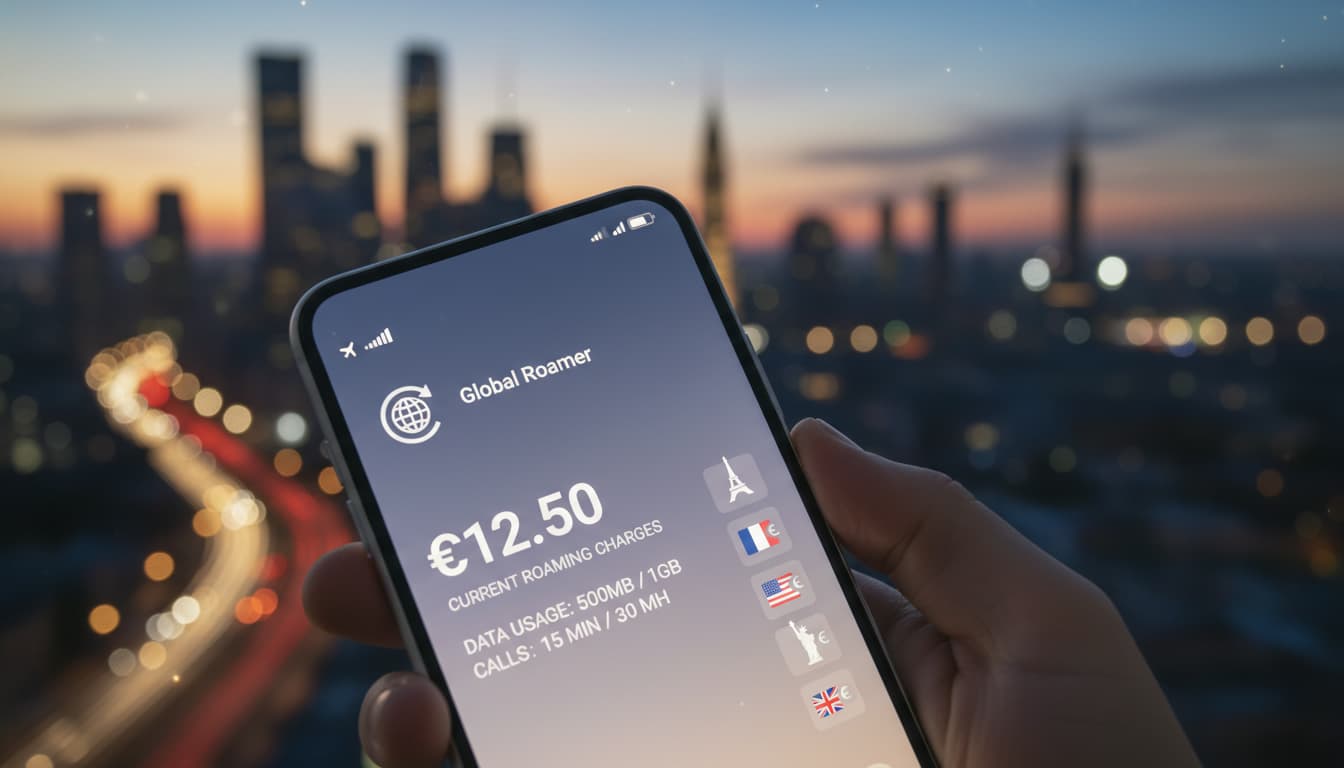

In short, what you will discover in this article: the key points to understand eSIM roaming fees abroad, how they are calculated, and most importantly how to avoid unpleasant surprises on your mobile bill while traveling. You will also find concrete tips to reduce these costs and manage your eSIM roaming efficiently.
1. Introduction — why care about eSIM roaming fees
Using an eSIM while roaming abroad can quickly lead to high costs if you don't know the rules of the game. Understanding eSIM roaming rates is essential to control your mobile budget and avoid hefty bills. When traveling, every megabyte consumed can weigh heavily on your bill, especially outside Europe. Hence the importance of anticipating and adopting best practices.
2. What is an eSIM and how it differs from a physical SIM
The eSIM is a virtual SIM card built into your smartphone, allowing the activation of an operator profile without physically changing the card. Unlike a traditional SIM, it offers greater flexibility, especially for managing multiple plans on the same device.
2.1 Technical overview (profile, activation, OTA)
Activation of an eSIM is usually done via a QR code or an app, which downloads the operator profile OTA (Over The Air). This profile contains all the information needed to connect to the mobile network. Managing profiles is simple, making it easy to switch from a local plan to an international one without changing the card.
3. How eSIM roaming fees are calculated
eSIM roaming fees depend on several factors that directly impact the final cost of your connection abroad.
3.1 Price factors — operator, country, plan type, usage (data/voice/SMS)
- The operator: each provider applies its own roaming fees, often higher outside Europe.
- Destination country: fees vary greatly depending on the geographic area (Europe, Americas, Asia, Africa).
- Plan type: local, regional, or global plans with very different prices.
- Usage: data typically costs more than calls or SMS, especially when roaming.
3.2 Typical pricing examples (short and long stay scenarios)
- A traveler in the United States might pay €15 for 10 GB with an eSIM, compared to over €130 in classic roaming.
- In Japan, a 10 GB eSIM costs around €20, while traditional roaming can reach €150.
- For a 10-day stay in Canada, savings can exceed €150 by choosing an appropriate eSIM.
These examples clearly show the possible savings thanks to eSIMs, especially in 2026 as rates become more competitive (source).
4. Before departure — 8 checks to avoid surprises
To prepare your trip well, here is a list of essential checks:
- Verify that your plan includes international or roaming options.
- Check the rates applied in your destination country.
- Disable data abroad if you want to avoid charges.
- Manually configure the network and APN to avoid automatic connection.
- Install and activate your eSIM before departure.
- Check your smartphone’s compatibility with eSIM.
- Prepare a local eSIM or a tourist data plan if needed.
- Inform your operator about your trip to avoid blocking or unexpected fees.
5. Alternatives to reduce fees
5.1 Buying a local eSIM or a tourist data plan
Purchasing a local eSIM in the destination country is often the most economical solution. These tourist data plans offer great value and avoid the high costs of traditional roaming.
5.2 International plans / operator packs / MVNO solutions
Operators also offer international or regional plans adapted to frequent travelers. Additionally, some MVNOs (mobile virtual network operators) provide competitive eSIM packages, often cheaper than classic plans.
6. Practical tips on site
6.1 Use Wi‑Fi and Wi‑Fi calling, manage background apps
To limit data consumption, favor Wi‑Fi whenever possible. Enable Wi‑Fi calling if your operator allows it to make calls via the internet. Also, close background apps that use data without your knowledge.
6.2 Switch between eSIM profiles and manage dual‑SIM to prioritize costs
If your smartphone supports dual-SIM, you can alternate between your main eSIM and a local eSIM to optimize costs. Always prioritize the profile with the most advantageous plan based on your usage.
7. Examples and case studies (quantified scenarios)
Here is a summarized table to better visualize the savings:
| Destination | eSIM plan (10 GB) | Classic roaming (10 GB) | Approximate savings |
|---|---|---|---|
| United States | €15 | €130 | €115 |
| Japan | €20 | €150 | €130 |
| Canada | €25 (5 GB) | €180 | €155 |
These figures clearly demonstrate the benefit of opting for an eSIM suited to your destination.
8. What to do in case of unexpected billing — steps and claims
If you notice unexpected roaming charges, here are the steps to follow:
- Check your phone settings, especially disabling data roaming.
- Contact your operator to request explanations and possible reimbursement.
- Provide evidence of your usage and published rates.
- In case of dispute, contact telecom regulatory authorities.
9. Conclusion & pre-departure checklist
To control the cost of roaming with eSIM, it is crucial to prepare your trip by checking your plan, configuring your phone properly, and considering alternatives like purchasing a local eSIM. These best practices will help you avoid surprises and fully enjoy your mobile connection abroad.
Don’t forget to consult our comprehensive guide on how to install an eSIM to be ready before you leave, and discover the best travel eSIM tailored to your itinerary. For in-depth understanding, start with what is an eSIM.
Finally, to get the most out of your eSIM while staying secure, consider using a reliable VPN, ensuring privacy and freedom of access during your travels.
Prepare your connected trip stress-free thanks to the eSIM!