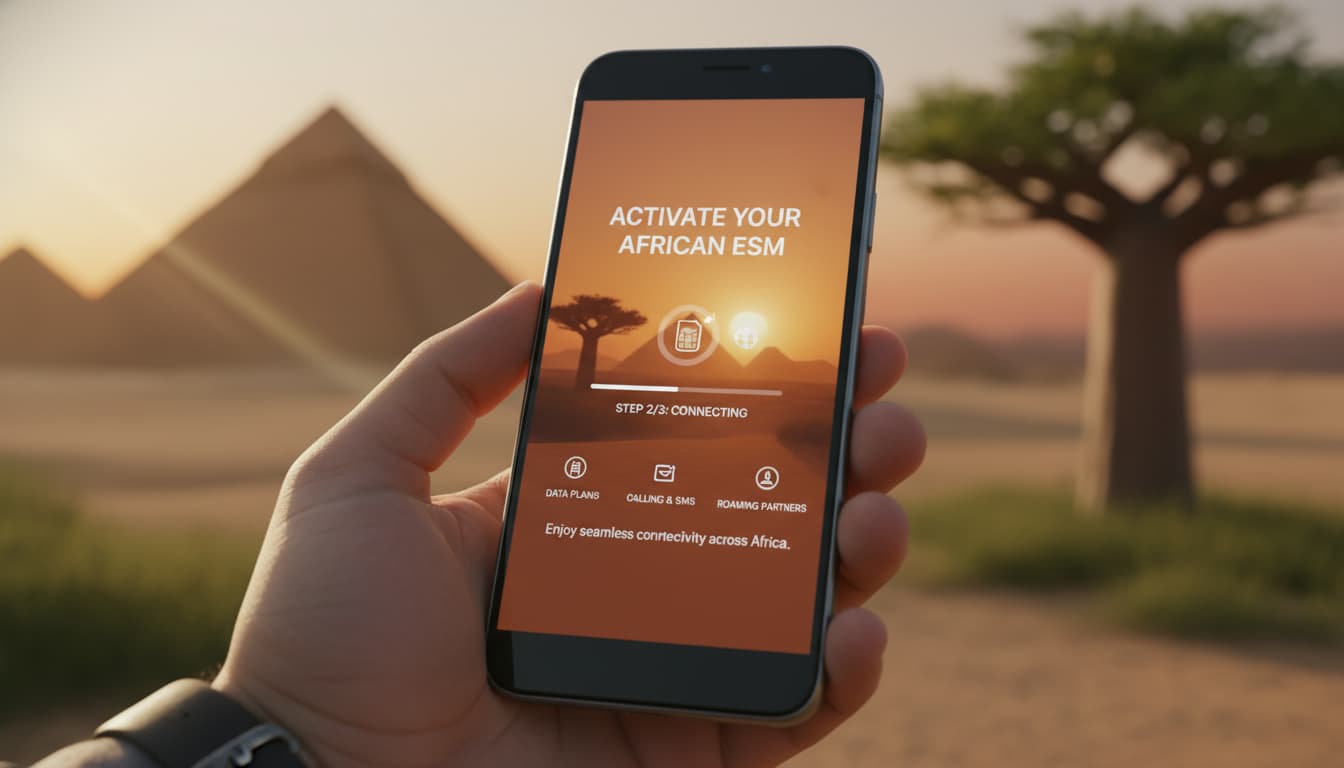

In short, here’s what you’ll learn in this article: why the eSIM is the ideal solution for traveling in Africa, how to choose and activate the right eSIM, device compatibility, plus practical tips for a reliable and secure connection throughout your journey.
1. Introduction — Why Choose an eSIM for Traveling in Africa?
The eSIM is revolutionizing how travelers stay connected, especially in Africa where swapping physical SIM cards can be tedious. The eSIM card for Africa helps you avoid waiting in lines, local administrative procedures, and excessive roaming fees. With an eSIM travel plan, you get instant activation and easy management via a mobile app. This guarantees a smooth eSIM internet connection in Africa, essential for checking maps, booking transport, or staying in touch.
2. Overview of eSIM in Africa
2.1 Which countries currently support eSIM?
Several major African countries like Egypt, Senegal, Kenya, and South Africa now offer reliable eSIM coverage. eSIM operators in Africa collaborate with well-known local networks such as MTN and Orange, ensuring good service quality in urban areas.
2.2 Legal limitations and restrictions to be aware of
Some regions still impose restrictions on eSIM use, mainly due to local regulations on user registration. It’s important to check these conditions before your trip to avoid any service interruptions.
2.3 General coverage and urban vs rural differences
eSIM coverage in Africa is generally excellent in major cities but may be limited in rural areas. For a safari or off-the-beaten-path travel, it’s recommended to choose a plan with ample data allowance and to verify coverage for your specific itinerary.
3. Device Compatibility
3.1 iPhone — compatible models and iOS versions
iPhones from the XR and XS models onwards, running iOS 12.1 or higher, support eSIM technology. To activate your eSIM on iPhone, check out our complete guide on how to activate eSIM on iPhone.
3.2 Android — models, versions, and special cases
Many recent Android smartphones, including Samsung, Google Pixel, and Huawei devices, are eSIM compatible. Configuration may vary depending on brand and Android version. For a successful setup, follow our tutorial on configuring eSIM on Android.
3.3 Check your device before departure (checklist)
- Verify your phone’s eSIM compatibility.
- Make sure the operating system is up to date.
- Test activating an eSIM in advance if possible.
- Back up your important contacts and data.
4. How to Choose the Right eSIM for Africa
4.1 International eSIM vs Local eSIM — comparison
| Criteria | International eSIM | Local eSIM |
|---|---|---|
| Coverage | Multi-country (up to 201 countries) | Specific to one country or region |
| Price | Often higher | Generally more economical |
| Activation | Instant via app, before departure | Sometimes requires local registration |
| Customer support | Centralized, often online | Local, sometimes in-store |
4.2 Choice criteria: price, data volume, validity, customer support
For travel in Africa, opt for an eSIM travel plan offering:
- A data volume suited to your usage (from 1 to 20 GB).
- Flexible validity (from 1 to 30 days).
- Responsive customer support in French.
- Compatibility with your eSIM-capable phone.
4.3 Quick list of covered countries by offer type (example summary table)
| eSIM Offer | Main Covered Countries | Indicative Price (USD) |
|---|---|---|
| Saily eSIM Africa | South Africa, Kenya, Senegal, Egypt | Starting at 14.99 |
| Airalo eSIM Africa | Multi-country (over 20 countries) | From 10 |
| Ubigi eSIM Africa | South Africa, Morocco, Egypt | Variable |
5. Step-by-Step Buying and Activation Guide
5.1 Buying online: steps and precautions
- Choose a reliable provider like Saily or Airalo.
- Select your plan based on duration and data.
- Create an account on the dedicated app.
- Check your phone’s compatibility.
- Pay online and receive your activation QR code.
5.2 Activation via QR/manual code/apps
Activation usually involves scanning a QR code in your phone’s network settings. Some apps allow automatic activation upon arrival or within 30 days of purchase, saving you time.
5.3 Troubleshooting common issues (activation failure, dual SIM, etc.)
- Restart your phone after activation.
- Verify the correct eSIM profile is selected in settings.
- For dual SIM, ensure the eSIM line is prioritized for data.
- Contact customer support via the app if needed.
6. Practical Uses and Field Tips
6.1 Connectivity on safari and in rural areas — real expectations
Internet eSIM connection in Africa may vary in remote areas. Bring a power bank and switch to airplane mode between uses to save battery.
6.2 Optimize data consumption and share connection
- Disable automatic updates.
- Use connection sharing cautiously to avoid excessive data use.
- Prefer lightweight apps for browsing.
6.3 Security and privacy while traveling
To protect your data, pair your tourist eSIM service with a reliable VPN. This secures your communications and prevents interception on public networks.
7. Quick Comparison of Options (providers / offer types)
7.1 Advantages and disadvantages of international vs local providers
- International: wide coverage, easy activation, but sometimes higher prices.
- Local: competitive rates, better local coverage, but sometimes more complex procedures.
7.2 How to read an offer: price, fair use, hidden limitations
Carefully read the terms of use, especially data caps, plan validity, and eSIM Africa roaming restrictions.
8. Specific Cases and FAQ
8.1 Multiple travelers/family: recommended solutions
For several travelers, prefer a multi-country eSIM with a large data volume, or multiple eSIM profiles on a single compatible phone.
8.2 What to do in case of connection loss or disputes?
Immediately contact customer support via the app or provider’s website. Keep your proof of purchase and screenshots to facilitate resolution.
9. Conclusion and Practical Recommendations
Before you leave, make sure you’ve activated your eSIM and tested the connection. Remember to back up your data and note customer support contacts. For a hassle-free trip, the eSIM is the key to reliable and economical connectivity in Africa.
For more details, check out our detailed article on the difference between eSIM and traditional SIM card and get ready for a connected journey with peace of mind.
Recommended Affiliate Links:
- Saily’s eSIM Africa plans with easy activation and extensive coverage: Saily - eSIM Africa Plans.
- Comparison of the best eSIMs for Africa to choose according to your needs: MyBestSim - eSIM Africa Comparison.